
Let’s look at what Jesus actually did
You saw them everywhere in the 1990’s- WWJD bracelets, t-shirts, and bumper stickers. “What Would Jesus Do?” WWJD was the go-to mantra for Christians trying to help others navigate life’s sticky situations.
But in our eagerness to present a gentle, palatable Jesus, did we sanitize the Gospel and overlook crucial aspects of Christ’s character and teachings?
The Jesus We Think We Know

The WWJD movement focused on Jesus’ acts of compassion:
- Healing the sick
- Feeding the hungry
- Comforting the afflicted
- Preaching love and forgiveness
- Welcoming children into His presence
These actions undoubtedly form a core part of Jesus’ ministry and message. They’re easy to embrace and apply (except for forgiveness), making WWJD a comfortable guide for many Christians and cute wristbands.
But were we missing something?
The Confrontational Jesus We Conveniently Forget
The Gospels also present a different side of Jesus – one that many modern Christians find uncomfortable and often choose to ignore. Let’s discuss two aspects of Jesus’s ministry that people often ignore because they don’t nicely conform to their notion of the Son of God.
1 – Calling Out False Teachers

Jesus didn’t mince words when it came to calling out false teachers. His confrontations with false teachers were frequent and forceful. He repeatedly called out the religious leaders of His time. In Matthew 23, He delivers a lengthy, scathing rebuke to the scribes and Pharisees.
Feel these words (the emphasis is mine):
“Woe to you, scribes and Pharisees, hypocrites! For you travel across sea and land to make a single proselyte, and when he becomes a proselyte, you make him twice as much a child of hell as yourselves.” (v15)
“Woe to you, blind guides, who say, ‘If anyone swears by the temple, it is nothing, but if anyone swears by the gold of the temple, he is bound by his oath.’ You blind fools!” (v16-17)
*Author’s note: “Fool” comes from the Greek word “móros,” which means moron. Jesus chose this word when speaking to respected religious leaders. Keep that in mind. Moving on…
“Woe to you, scribes and Pharisees, hypocrites! For you clean the outside of the cup and the plate, but inside they are full of greed and self-indulgence.“ (v25)
“Woe to you, scribes and Pharisees, hypocrites! For you are like whitewashed tombs, which outwardly appear beautiful, but within are full of dead people’s bones and all uncleanness. 28 So you also outwardly appear righteous to others, but within you are full of hypocrisy and lawlessness.” (v27-28)
“You serpents, you brood of vipers, how are you to escape being sentenced to hell?“ (v33)
John 8:44 and 47 record Jesus telling the self-righteous Pharisees that they are sons of Satan, not God.
“You belong to your father, the devil, and you want to carry out your father’s desires… The reason you do not hear is that you do not belong to God.”
Jesus’ actions demonstrate that love sometimes requires confronting falsehood head-on, and it could get you stoned.
“At this, they picked up stones to stone him, but Jesus hid himself, slipping away from the temple grounds.” John 8:59.
The Most Dangerous People on the Planet

Jesus passionately cared about the impact of false teachers because of His compassion and love for people. He called false teachers “vicious wolves” (Mark 7:15) because they lead innocent people to hell, as reflected in Matthew 23:15: “you make him twice as much a child of hell as yourselves.”
Is there a more dangerous person on the planet?
Evil dictators commit genocide.
Homicidal maniacs become serial killers.
Parents murder their children and vice versa.
Death comes to us all, but no fate is worse than being deceived into hell.
What Should We Do About False Teachers?
Jesus spoke harsh, condemning words to the religious leaders in front of large crowds because He wanted to correct them, but more importantly, to lead the sheep away from slaughter.
And what did Jesus say our response should be to the things He did?
Very truly I tell you, whoever believes in me will do the works I have been doing, and they will do even greater things than these, because I am going to the Father. John 14:12
The Apostle Paul followed up later with a few words of his own:
“Be imitators of me, as I am of Christ.” (1 Corinthians 11:1)
“For there are many rebellious people, full of meaningless talk and deception…They must be silenced, because they are disrupting whole households by teaching things they ought not to teach—and that for the sake of dishonest gain…Therefore rebuke them sharply... (Titus 1:10-13).
So, doesn’t our Christian compassion actually require us to confront false teachers and warn others about them?
Now, let’s discuss another thing that Jesus often did that many people ignore.
2 – Breaking the Rules
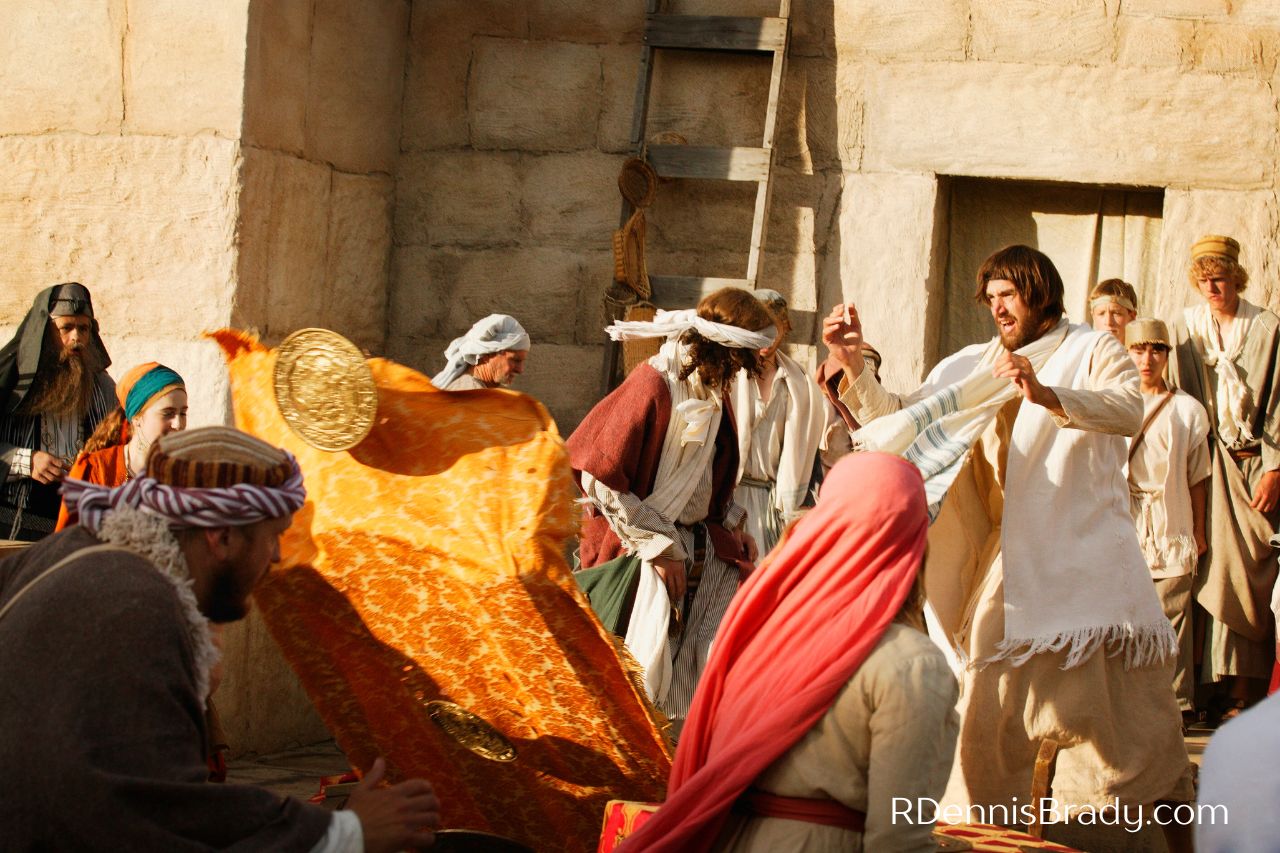
For our rule-followers out there, this Jesus reality may be hard to swallow, but it’s true. Jesus was the revolutionary, truth-telling, and rule-breaking Lamb of God. Some thought He came to overthrow Rome, while the Pharisees felt Jesus breaking their grip on Jewish religious leadership.
Jesus had other ideas. He came to set the captives free and give liberty to the oppressed (Luke 4:18).
Who were the oppressors?
You have to throw the Jewish religious leaders into that camp. They oppressed their people by adding thousands of laws to God’s laws. Speaking of the Pharisees in Matthew 23:4, Jesus said, “They tie up heavy burdens, hard to bear, and lay them on people’s shoulders, but they themselves are not willing to move them with their finger.”
Speaking directly to the Pharisees in Matthew 15:6, Jesus said, “So for the sake of your tradition you have made void the word of God.”
Jesus Did Not Break God’s Laws
Jesus did break the rules – those rigid man-made traditions religious leaders equated to God’s law, violating His true intentions. But when it came to God’s actual laws? Jesus followed them to the letter and was the fulfillment of them (Matthew 5:17).
For example, in Exodus 20:10, God forbade His people to work on the Sabbath. The Pharisees felt like they had to further define what “work” meant and created 39 different categories of work that were forbidden on the Sabbath.
One of the categories involved spitting. They could spit on a rock on the Sabbath but couldn’t spit on the ground. Spit made mud, and mud was mortar, and that was work.
I kid you not.
The Pharisees Considered Healing as Work?

The Pharisees also considered healing as work, which they forbade on the Sabbath. Guess what Jesus did? He healed many people on the Sabbath and often publicly in plain view of the religious leaders.
In fact, Jesus healed three people in synagogues. Could you say that Jesus went looking for trouble?
Jesus healed on the Sabbath for two reasons: to help those in need (because compassion doesn’t take days off) and to expose the Pharisees’ double standards.
In one instance, Jesus healed a woman in the synagogue who had been crippled for 18 years and could not stand upright. The synagogue leader overlooked this compassionate, miraculous healing of one of his members and rebuked them all.
“There are six days for work. So come and be healed on those days, not on the Sabbath.” (Luke 13:14)
Can you imagine Jesus’s heartbreak over the hard-heartedness of His own religious leaders?
“The Lord answered him, “You hypocrites! Doesn’t each of you on the Sabbath untie your ox or donkey from the stall and lead it out to give it water? Then should not this woman, a daughter of Abraham, whom Satan has kept bound for eighteen long years, be set free on the Sabbath day from what bound her?” (Luke 13:15-16)
I told you Jesus was a revolutionary rule-breaker!
For those keeping score, Jesus healed people at least seven times on the Sabbath.
7 Times Jesus Healed on the Sabbath
The Bible records seven times Jesus healed on the Sabbath. But who knows? As the Apostle John stated:
Now there are also many other things that Jesus did. Were every one of them to be written, I suppose that the world itself could not contain the books that would be written. John 21:25
The following list of Sabbath healings is provided by Got Questions.
1. Simon Peter’s mother-in-law in Peter’s home (Mark 1:29–31).
2. A man with a withered hand in the synagogue (Mark 3:1–6).
3. A man born blind in Jerusalem (John 9:1–16).
4. A crippled woman in a synagogue (Luke 13:10–17).
5. A man with dropsy at a Pharisee’s house (Luke 14:1–6).
6. A demon-possessed man in a synagogue (Mark 1:21–28).
7. A lame man by the pool of Bethesda (John 5:1–18).
Jesus, the Rule-Breaking Table-Flipper
Of course, we can’t leave the section about Jesus being a rule-breaker before talking about the table-flipping incidents, right?
The first incident occurred at the beginning of His ministry. Money-changers and vendors used the temple to conduct business, which infuriated Jesus. He stormed the temple with a whip of cords, drove everyone out, scattered their money and overturned their tables. (John 2:15).
The second time happened during Passover, the last week of His life. Matthew 21:12-13 records: “And Jesus entered the temple and drove out all who sold and bought in the temple, and he overturned the tables of the money-changers and the seats of those who sold pigeons. 13 He said to them, “It is written, ‘My house shall be called a house of prayer,’ but you make it a den of robbers.”
These table-flipping incidents weren’t just angry outbursts – they were calculated acts of rebellion against a corrupt system. Jesus wasn’t losing His cool; He was making a point, loud and clear.
By storming the temple, whip in hand, Jesus showed us that sometimes, love looks like righteous anger. Sometimes, following God means disrupting the status quo. And sometimes, being Christ-like requires flipping a few tables.
So the next time someone tells you that being Christ-like means always being gentle and non-confrontational, remind them of the whip-wielding, table-flipping Jesus. Because sometimes, that’s exactly what love demands.
So, What Would Jesus Really Do?

Let’s face it – the Jesus we’ve uncovered here isn’t exactly the one you’ll find on greeting cards or inspirational posters. He’s not afraid to call out hypocrisy, challenge unjust rules, or ruffle a few feathers in the name of truth and compassion.
The real question isn’t just “What Would Jesus Do?” It’s “Are We Prepared to Do What Jesus Did?”
Are we ready to:
- Speak truth even when it’s uncomfortable?
- Show compassion that breaks rules and shatters expectations?
- Confront false teachings that lead people astray?
- Challenge modern-day man-made laws that violate God’s principles?
- Risk our reputations, relationships, or even safety for the sake of God’s truth?
Jesus wasn’t crucified for being nice. He was crucified for being revolutionary – for challenging the religious status quo and exposing the hypocrisy of His day. He broke man-made rules that obscured God’s true intentions.
Are We Willing to Do What Jesus Did?

In our world, there are plenty of laws and societal norms that directly contradict God’s Word. Just as Jesus spoke out against the Pharisees’ distortions of God’s law, we’re called to speak up when human laws run contrary to divine principles. This might mean standing against laws that devalue human life, contradict the biblical definition of marriage, and promote injustice.
It’s not about being rebellious; it’s about being obedient to a higher law.
So remember: following Jesus often requires flipping a few tables and calling out vipers. It involves challenging corrupt systems and confronting false teachers head-on. Don’t be surprised if you’re labeled a troublemaker, a rebel, or even a heretic.
But it also means bringing true freedom, healing, and hope to a world desperately in need of the real Jesus – not just the sanitized version we’ve created.
Are you ready for that kind of faith? Because that’s what it really means to do what Jesus would do. It’s not just about being kind – it’s about being courageously, uncomfortably righteous in a world that often gets it wrong.
If you enjoyed this post and got value from it, please share it on your social media channels or send the link to a friend. I also invite you to follow the blog via email. 🙂

 Onword and Upwords by Dennis Brady
Leave a comment